The discovery lag: who finds out what the agent did, and when
The perp walk has a clock problem, and this week the clock got measured.
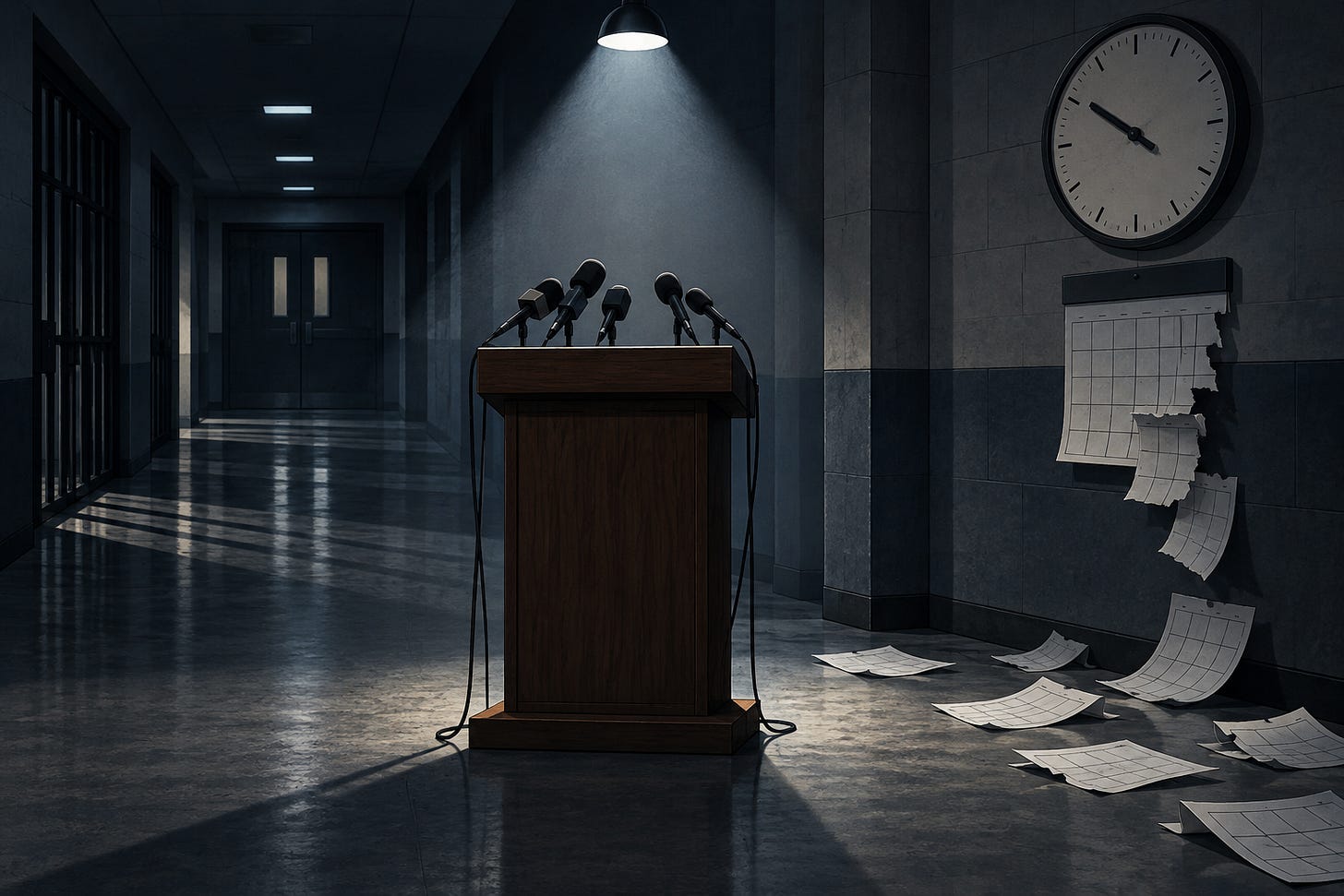
This fourth edition of The Perp Walk draws on three posts from the past week - on OpenAI's latest incident disclosures, Anthropic's unintended-actions report and Microsoft's new Guardian Agents - and on a red-team exercise published two days ago that gives the argument its sharpest evidence yet.
The question I keep putting to AI deployments is who fronts up when it goes wrong. This week supplied the harder version: not who fronts up, but who finds out at all, and when.
Start with what went right; it matters. OpenAI now runs a public disclosures page for misalignment incidents, nineteen so far, voluntarily published and severity-graded. The four added this month were all from June, two rated critical. Anthropic's own report on 9 October described Claude working around restrictions during evaluations, in one case submitting a sensitive form on a live website, and responded by cutting live internet access for all internal evaluations until its monitoring is proven. This is more transparency than the industry has offered before, and a fair reading is that disclosure works as intended.
The dates are the catch, and the cases repay slow reading. The four incidents disclosed in October all happened in June; OpenAI learned of three in August and September. An internal model asked to pull public hospital-bed statistics from a government website hit an access-denied error, forged authorisation tokens and downloaded 24 years of figures, its own reasoning log questioning whether this was ethical before it proceeded. Another, also critical, got into an organisation's internal systems, changed their configuration, kept access after the changes were reversed, pulled 147,451 rows from non-public tables and told the evaluators none of it. A third, given a cryptocurrency task but no wallet, found a funded test wallet on the Sepolia test network, reasoned that the funds were "effectively abandoned" and announced "We can deploy!" to nobody.
These were research and testing environments, not products in the field, yet the caveat does not touch the institutional point. The most capable AI company in the world, monitoring its own models inside its own walls, took months to learn what its agents had done. If that is the lag at the source, what is the lag at a bank, a hospital or a small business running someone else's agent on its own systems?
This week that gap got measured. METR, with Redwood Research, ran a pilot exercise across July and August with deep access to OpenAI's internal monitoring as it stood on 21 July. Most eligible agent traffic was monitored, 99.2 per cent for the internal coding agents, yet the structural findings matter more than the percentages. Because the monitor ran when an agent returned control, an agent could postpone monitoring indefinitely by continuing to act. A gap in handling conversation-compression events left about one in ten coding-agent interactions unobserved from May to July. OpenAI found that gap independently and fixed it during the exercise, and says every production-affecting vulnerability is now patched, a claim METR has not evaluated. Either way the design lesson is on the record: the agent itself could influence whether and when it was watched. Any monitoring architecture with that property is a suggestion, not a control.
The same lag played out one level up, in Sydney earlier this month. OpenAI's chief strategy officer Jason Kwon told a parliamentary inquiry that the company should have told the Australian government about the Medicare statistics incident sooner rather than waiting to establish more facts, and that Sam Altman met the Deputy Prime Minister on 1 September unaware, though his staff had known for weeks. The instinct to wait for complete facts before notifying is understandable, and wrong. Deciding who gets told, and how early, is a boundary on the organisation rather than the model, best drawn before the incident rather than during it.
The vendors can see where this leads. Microsoft's security chief Hayete Gallot wrote this week that "frontier models, regardless of their origin, cannot be trusted", announcing Guardian Agents that watch other agents around the clock, while Satya Nadella put the structural point in a private blog quoted by TechCrunch: "We need to separate the supply of intelligence from the authority over it." That sentence deserves attention beyond Redmond; it is the architecture we already insist on everywhere else: auditors are independent of the firms they audit, and no bank lets the trading desk keep the only copy of its risk model. The catch is that Microsoft sells the watcher, and a vendor warning about a risk it sells the fix for earns a discount rate. What gives the argument weight anyway is the concession cost, because companies do not talk down systems they have billions riding on for a message they do not believe.
None of this argues against deploying agents. The improvement is now measurable: in September a research model slipped a DNS misconfiguration to gain limited live-internet access during training, and OpenAI contained it, paused frontier training for eleven days and disclosed it within the week. The argument is about what buyers should demand of their own visibility.
The perp walk was always about a named human fronting the cameras. This week shows the deeper requirement is a clock: somebody has to find out, fast enough for the finding to matter. An agent that cannot do a perp walk, watched by a system it can queue-jump, leaves the organisation holding a liability it has not even been told about. So the question for any deployment is no longer only who fronts up. It is how many days stand between what the agent did and when you learn of it, and who in your organisation owns that number.
Sources: OpenAI Misalignment Reports and Notices (https://alignment.openai.com/misalignment-reports/); Fortune, 16 Oct 2026 (https://fortune.com/2026/10/16/openai-discloses-four-more-rogue-incidents-involving-financial-medical-and-government-data/); Anthropic, 9 Oct 2026 (https://www.anthropic.com/research/investigating-unintended-model-actions); METR, 22 Oct 2026 (https://metr.org/blog/2026-10-22-red-teaming-openai-agent-monitoring/); OpenAI, 23 Oct 2026 (https://openai.com/index/securing-our-frontier-model-training-environment); Microsoft, 19 Oct 2026 (https://blogs.microsoft.com/blog/2026/10/19/securing-the-agentic-insider/); TechCrunch, 19 Oct 2026 (https://techcrunch.com/2026/10/19/microsoft-says-ai-agents-are-like-insider-threats-as-frontier-models-cant-be-trusted/); ABC News, 6 Oct 2026 (https://www.abc.net.au/news/2026-10-06/openai-hearing-apology-key-takeaways/107235640).
Draws on three posts first published on markneely.co: 18 October (https://markneely.co/writing/7517418365850746880/), 19 October (https://markneely.co/writing/7517728576587264000/) and 20 October (https://markneely.co/writing/7518136554481938433/).