The whole ledger: a cheap task is not yet a cheap service
The token bill is the part of AI's cost that fits on a dashboard. The rest is still looking for an owner.
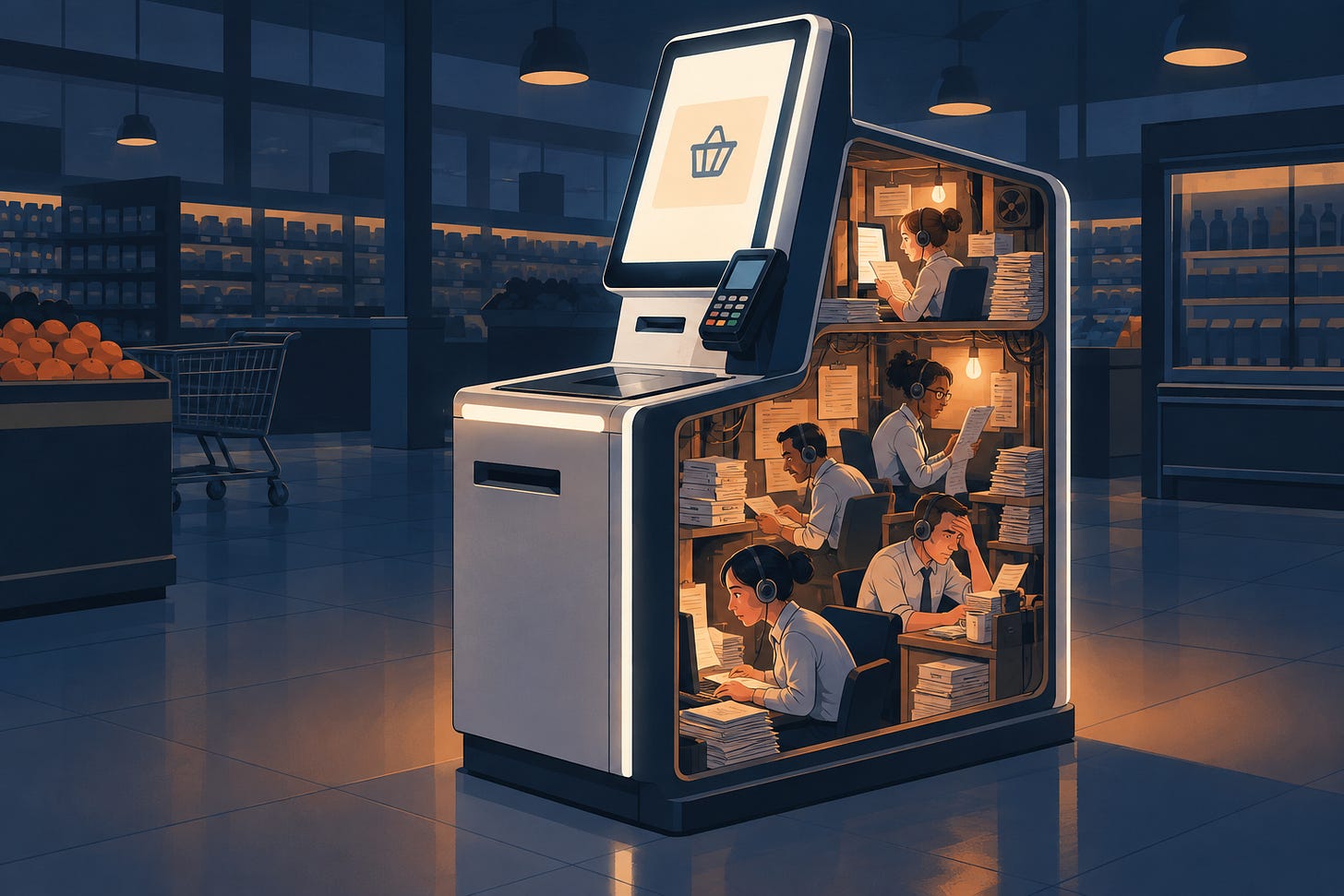
This fifth edition of The Perp Walk draws on four posts from the past week - on McKinsey's case for engineers embedded inside the client, the costs automation pushes outward, Accenture's US$29 Claude ration and TCS's uncomfortable AI revenue headline. The thread connecting them is a number that keeps going missing.
The AI industry sells a cheaper task. Take the claim at face value: drafting, coding, summarising and reconciling all cost less than they did, and the business cases built on those savings deserve to be taken seriously. Yet the firm whose business is selling that future now describes the work of getting there very differently. McKinsey's explainer on the forward-deployed engineer concedes that the line between engineer and consultant is blurring, with one of its own leaders calling the roles merged, and defines the job as sitting inside the client's systems and data until a product exists and a process has changed. "You can't just go in, deliver insights, and walk away," says McKinsey's Nick Robson. When the firm that perfected walking away says you cannot walk away, the economics of the cheap task deserve a second look.
The fair counter is that embedded labour is temporary: engineers resolve the early integration problems, then standard products take over and margins return. That may happen, but it cannot be assumed in this quarter's business case. None of these sources puts a number on how long that labour lasts, so a buyer pricing it at zero is guessing.
Even where the task is genuinely cheap, the service is something else. In a long essay this month, Natália Tôrres argued that efficiency gains inside a service often arrive alongside costs pushed outward, onto the people who depend on it. The dashboard sees handling time fall; it does not see the staff member hovering over the self-checkout lane, the customer doing the data entry a broker once did, or the employee checking machine output for errors that are rarer but stranger. Some transferred cost is real progress, because work genuinely does vanish. The honest test is whether the total cost of the service fell, or only the part your own dashboard can see.
The same wrong-number instinct showed up inside one of AI's loudest advocates. 404 Media reports that Accenture, which encourages its clients to invest heavily in AI, has capped many of its own staff at US$29 a month of Claude usage, including people who had been spending as much as US$1,000. The irony writes itself; the more useful question is what it reveals about the governance underneath. Software licences trained a generation of finance teams to think in seats: fixed cost, more use, better return. Consumption pricing inverts that logic, because the bill rises with the most serious users, and whether those users are also the most valuable is exactly what a ration never tells you, since a flat cap treats the power user and the casual experimenter as the same person. The mistake is not the cost control but the number being controlled. Value per dollar of AI spend - which teams use the tool, what work it touches, what comes out the other end - is a number a CFO can govern, while a monthly ration governs only the invoice.
The supplier's own scorecard shows why this matters now. TCS reported US$3.1 billion of annualised AI revenue in its September quarter, more than 10 per cent of the company, while total revenue grew 0.2 per cent in US dollar terms; it also signed US$9.6 billion of new contracts at a 24 per cent operating margin, so nobody should write the obituary. What the flat total means for the rest of the business is an inference rather than a reported fact, and it is Tech Economics that makes it: AI revenue arriving while automation and pricing pressure erode the traditional work it was sold to improve. For buyers the lesson is not that the big firms are dying, but that their incentives are moving, and fees tied to completed outcomes rather than hours are a negotiating direction worth taking now, before invoice relabelling settles in as custom.
Put the four together and a pattern emerges. Where the task is cheap and getting cheaper, the service around it - integration, exceptions, supervision, residual risk, the effort handed to customers - is where more of the cost now sits. The risk is split accountability: finance sets the token cap, IT owns the integration overrun, operations carries the exception queue, and the customer's effort can fall between all of them, each number defensible on its own and the sum of them unmanaged.
The question I keep putting to AI deployments is who fronts up when it goes wrong. The buyer's version is quieter: when the cheap task becomes an expensive service, who owns the difference? The accountable executive should hold one number, value per completed service including residual cost and the cost of reversing a failure, and should hold it before the vendor's invoice and the internal dashboard agree to look away. If the residual cost is sitting with your customers, what you have is not a saving but a transfer, and customers keep accounts too.
Sources: McKinsey Explainers: What is a forward-deployed engineer? (16 Oct 2026); The Curious Society: The Real Price of Automation, Natália Tôrres (16 Oct 2026); 404 Media: Accenture Tells Employees They Can Now Spend Only $29 on Claude Per Month (15 Oct 2026); TCS Q2 FY2027 results (8 Oct 2026); Tech Economics: AI Is Eating the Business That Sells It (14 Oct 2026).
Draws on four posts first published on markneely.co: 27 October, 28 October, 29 October and 30 October.